

Identifying and Replacing Bad Habits

I came across this quote from James Clear, author of Atomic Habits, that really resonated with me and my work with my clients. He stated, “The most expensive part of a bad habit is rarely the action itself, but rather the identity it quietly reinforces underneath. The issue isn't skipping once. It's that you practiced being someone who skips.”
I had recently put together this story for a class that Diane Quintana and I are presenting. It is a compilation of stories I have heard from my client.
It’s been a hard day at work, and you have stayed late to finish up a project that is due tomorrow. You are so ready to get home and put your feet up.
You get in your car and notice that your gas gauge shows that you are low on gas but you are pretty sure you have enough gas for one more day. However, you do need to pick up a few things at the grocery store for dinner tonight and breakfast in the morning.
You stop at the store for a quick run through. You don’t have a list and you end up walking out with 5 bags of groceries.
You finally arrive home and decide you had better stop at your mailbox and pull out the mail. You’re pretty sure you didn’t check it yesterday. You grab out the mail and shove it into one of the grocery bags.
You unload the grocery bags from the car and put them on your kitchen counter. You are so tired. You just want to rest for a while. But first you do pull out of the bags the few things that need to be put into the refrigerator.
Then you grab a beverage and go into the living room, kick off your shoes, and decide to check your social media. You do not set a timer so before you realize it, you have spent over an hour scrolling.
You realize that you need to fix yourself some supper but you really don’t feel like cooking so you put together a sandwich and grab some chips. You go back into the living room to eat while you watch some TV.
You fall asleep on the couch and wake up past midnight. You drag yourself to bed.
The next morning the alarm goes off and you know you can’t ignore it. You drag yourself to the kitchen to put on some coffee and while it is brewing you jump into the shower.
When you start to get dressed you realize that the top you had intended to wear is in the dirty clothes hamper. You dig around in your closet to find something else to wear that looks professional.
You don’t have time for breakfast now so you fill up your to-go mug with coffee and grab a couple of breakfast bars.
You put out fresh food and water for your cat and promise that you will address the litter box this evening.
You grab your business bag and hope that you have what you need in it – and you probably do since it has not been touched since you brought it home last night.
But where are your car keys? They are not in your purse or beside your purse. They are not on the table or coffee table. You finally find them on the kitchen counter between the still unpacked grocery bags.
With a prayer that traffic is not going to be bad and that your gas will hold out, you are finally off to another day at work.
This scenario has our person building bad habits on bad habits. They are at this point exhausted and overwhelmed. They identify themselves as someone who is incapable. This is often when they call us.
While we would love to wave a magic wand and make this all better, we know that we need to have them start slowly and substitute bad habits for ones that serve them one habit or two at a time.
I would like them to start by making a list of what they did over those couple of days that got them into the current meltdown.
The list might look like this:
· Not leaving work at a regular time. Often staying late to finish projects. Yes, occasionally this might happen but don’t let it be a habit.
· Not taking the time to gas up before it becomes critical. This might mean looking ahead in their week and seeing a time where they were near a gas station with a bit of time where they could gas up even if they still had almost ½ a tank.
· Not scheduling regular grocery shopping times and having a list. Even better yet, having menus planned for the week.
· Not checking and sorting mail daily. Once a week scheduling a time to deal with mail that needs an action.
· Not putting groceries away and clearing your kitchen counter.
· Not setting a timer when scrolling through social media.
· Not having a planned meal that is easy to fix.
· Not setting an alarm to remind you that it is time to prepare for bed.
· Not scheduling a regular laundry schedule.
· Not scheduling other maintenance chores like cleaning out the cat box.
· Not unpacking and checking your work bag.
· Not having a home for your car keys.
Wow! The list is overwhelming and where would you start?
If I were working with this person, I would strongly suggest starting with setting up the habit of a regular bedtime. If they were getting enough sleep, a lot of this might take care of itself.
Having said that, I have been working with one of my clients for a long time to convince her to do this very thing. It seems to be a very difficult habit to change. We can agree that she should set an alarm for 10:00 to start getting ready for bed and aim for actually in bed by 10:30. We can agree that she should be up by 6:30 to start her day. But she often drags herself home after 8:00 and although she has tried several times, it seems a difficult change for her to make. I have not given up on it yet.
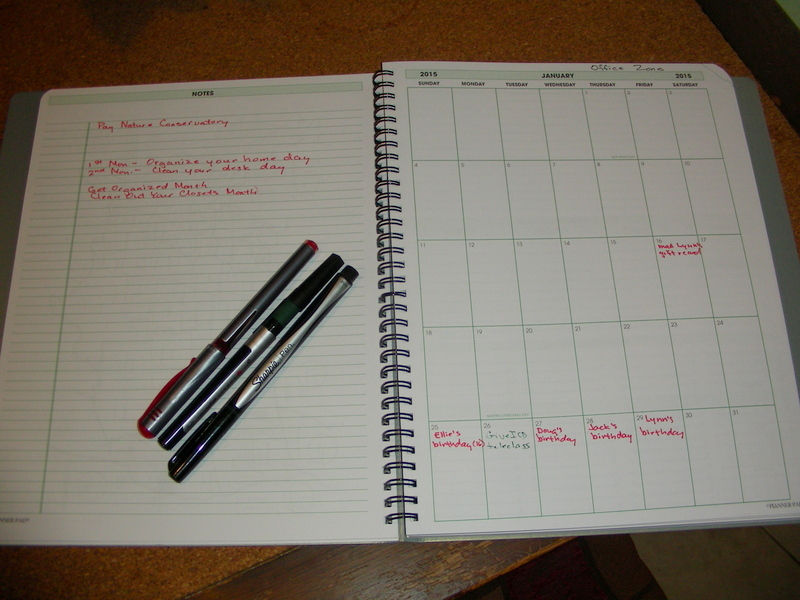
The next habit I would like them to work on is using a calendar. I would like them each week to write in meetings and work times that they know about. This would include any appointments. Then look at each day and see when they could schedule all maintenance chores for the week.
If this was a client that was working with me either weekly or every other week, I would ask them to check in every evening with a short text telling me what did get done and/or what stopped them from doing what they had planned on doing. This gives them accountability.
Bad habits, once identified, can be changed over time.
If you are trying to drop some bad habits and create and maintain supportive habits, join Diane and me for our monthly class on the Benefits of Creating and Maintaining Supportive Habits and Routines.
Jonda S. Beattie, Professional Organizer owner of Time Space Organization, and co-owner of Release, Repurpose, Reorganize. She is based in the Metro-Atlanta area. As presenter, award-winning author, as well as a retired special education teacher she uses her listening skills, problem solving skills, knowledge of different learning techniques, ADHD specialty, and paper management skills to help clients.



Ouch! I also love James Clear. And this one really hit me in the gut "The issue isn't skipping once. It's that you practiced being someone who skips.” Our habits reflect our values and our identity, and so it is definitely worth doing a habit review regularly.Thanks for the reminder. :-)
Although I don't face those problems (thankfully), I understand why your client wouldn't want to go to bed only two hours after getting home. If she's going to eat and clean up, it leaves next to time to unwind before trying to go to sleep. That may not be enough for some people.
The story you shared is heartwrenching and not uncommon. It's those small things we do or don't do that can derail us, overwhelm us, and exhaust us. They can also make things feel hopeless.
Changing habits isn't easy. Taking the approach of doing one small shift at a time is a positive way forward. And even with that change, it has to be tiny enough not to overwhelm the person making it.
It's interesting how you started with the scenario you shared; you began by changing the sleep habit. That can be the key for many people. When you start the day not exhausted, you have the capacity to focus on making more changes.
Thanks for sharing your view, Jonda. We tend to go in autopilot each day. Awakening to the bad habit and wanting to stop it is key to changing it. Motivation is key to figuring out what to do next.
Exhaustion is a common theme that I see around bad habits. There often feels like more to do than there is time, and this sense that everything is out of control. This scenario you shared feels kind of hopeless and frustrating.
Habits, when kept, can help us know when to push through and when to stop. So yes, stay strong and unpack the groceries, but then keep to your bedtime. Tools like the calendar can really add that structure we may be lacking. Many people never learn to use tools because they just "keep it all in their head." The problem comes when life gets too full to be held in readily accessible memory. I think of my calendar and…